Self-driving labs (SDLs)
SDLs use AI and automation to reduce the time and cost of bringing new materials to market, from an average of 20 years and $100 million to as little as one year and $1 million.
The number of potential materials exceeds the number of atoms in the observable universe; consequently, researchers have explored only a small corner of chemical space.
Traditional methods for discovering new materials are slow and ineffective. At the Acceleration Consortium, we build SDLs to accelerate the discovery of new materials for a fraction of the usual time and cost.

How SDLs Work
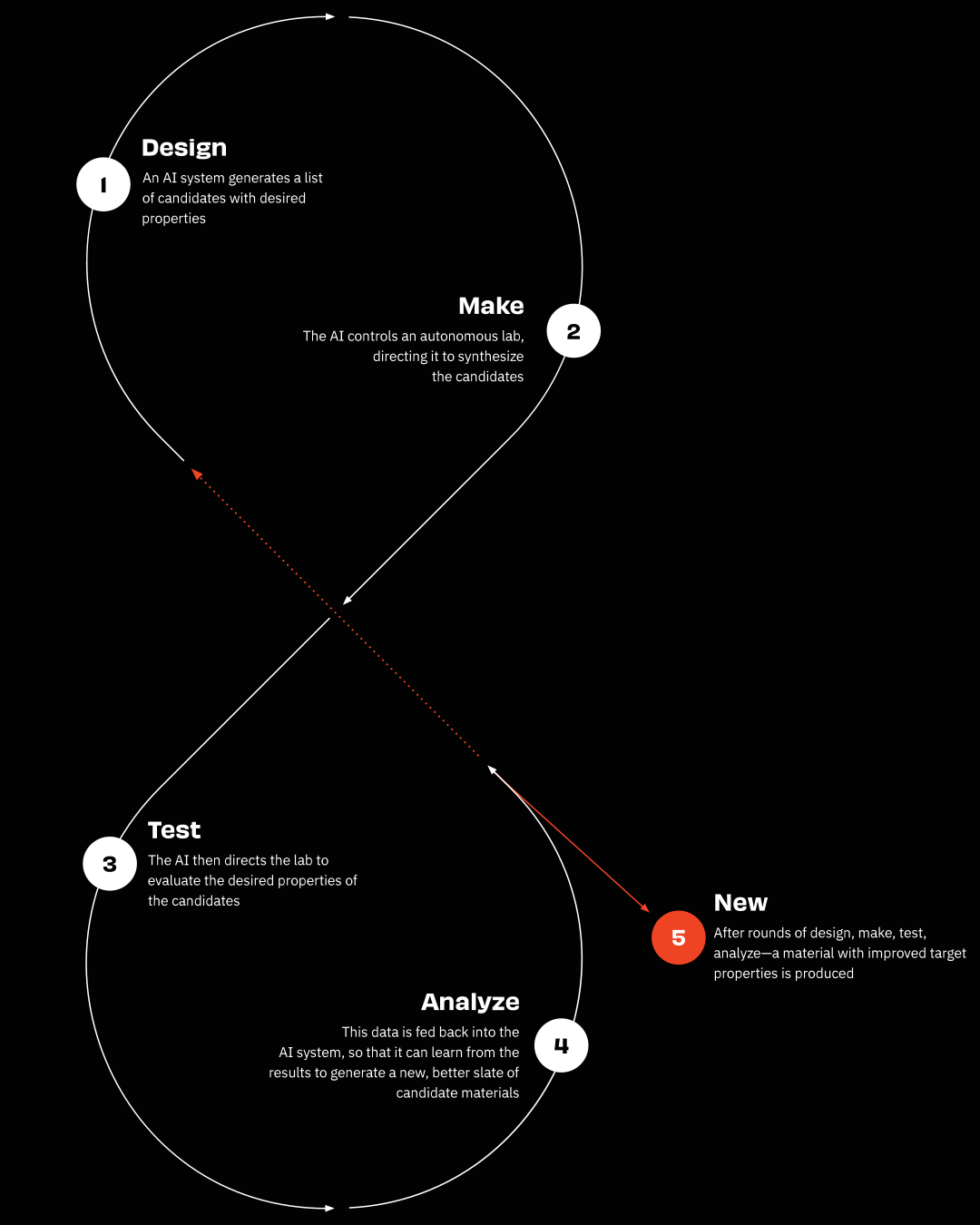
Like a self-driving car, SDLs use AI and automation, but instead of getting a passenger from point A to B, these autonomous labs create new materials in a smarter way. By inverting the usual discovery process, self-driving labs (SDLs) allow scientists to first define the properties they desire and then work backwards to make the material in an iterative, closed-loop cycle:

An AI system generates a list of candidates with desired properties
The AI controls an autonomous lab, directing it to synthesize the candidates
The AI then directs the lab to evaluate the desired properties of the candidates
This data is fed back into the AI system, so that it can learn from the results to generate a new, better slate of candidate materials
After rounds of design, make, test, analyze–a material with improved target properties is produced

Self-driving labs can be used to discover or optimize almost any type of material or molecule, many of which that are critical for addressing the world’s major challenges, like sorbents to capture CO2 from the atmosphere, membranes to filter water, and molecules to treat cancer.
The incredible potential of materials to create new technologies and transform everyday products is estimated to yield a $1 trillion industry over the next decade. More than this, we have the potential of creating a world of safer, more sustainable materials that will improve our environment and our well-being.

The advantages of accelerating discovery
Unlike traditional labs, SDLs can:
Explore more possibilities by predicting which of the nearly infinite ways to combine materials will yield the best results
Increase efficiency by using AI instead of trial and error to determine which experiments will provide the most information
Make science easier to reproduce through AI and automation
Hand off manual lab work to robots so scientists can focus on higher-order tasks like designing better experiments, interpreting results, and redefining what’s possible
Hand off manual lab work to robots so scientists can focus on higher-order tasks like designing better experiments, interpreting results, and redefining what’s possible
Values-based research design
As materials discovery becomes rapid, inexpensive, automated, and democratized, it is essential that we, with community partners, be guided by shared values. Our values can work positively to ensure that the broader impact of materials is considered before they are deployed and that their production is towards collective benefit and sustainability. These values demonstrate our commitment to open science, collaboration, agility, diversity and inclusion, as well as the importance of Indigenous approaches to sustainability and governance, including the CARE Principles for Indigenous Data Governance:

Care and reciprocity
Timeliness and connecting back to values
Processual consent
Sustainability and harm reduction
Data justice
Collective benefit, community governance, and accountability
Accessibility and open listening
Meaningful transformation
SDLs are an emerging technology that cannot be purchased off the shelf; they are often expensive to build, difficult to reproduce, and require expertise across many disciplines to operate.
The AC aims to make this technology modular, affordable, and easy to use. Only by speeding up science will we have a real chance of tackling some of the most pressing global problems that demand new materials—and only by democratizing this technology can we get this done. SDLs will enable a future where AI and automation handle the repetitive, time-consuming parts of lab work so that we can focus on what matters most: asking better questions and developing impactful solutions.