Acceleration Consortium announces its first two faculty Accelerator awards recipients, each valued at $750,000
Awards were given to Drs Benjamin Sanchez-Lengeling and Weilai Yu as new faculty who both joined the Department of Chemical Engineering & Applied Chemistry at the University of Toronto

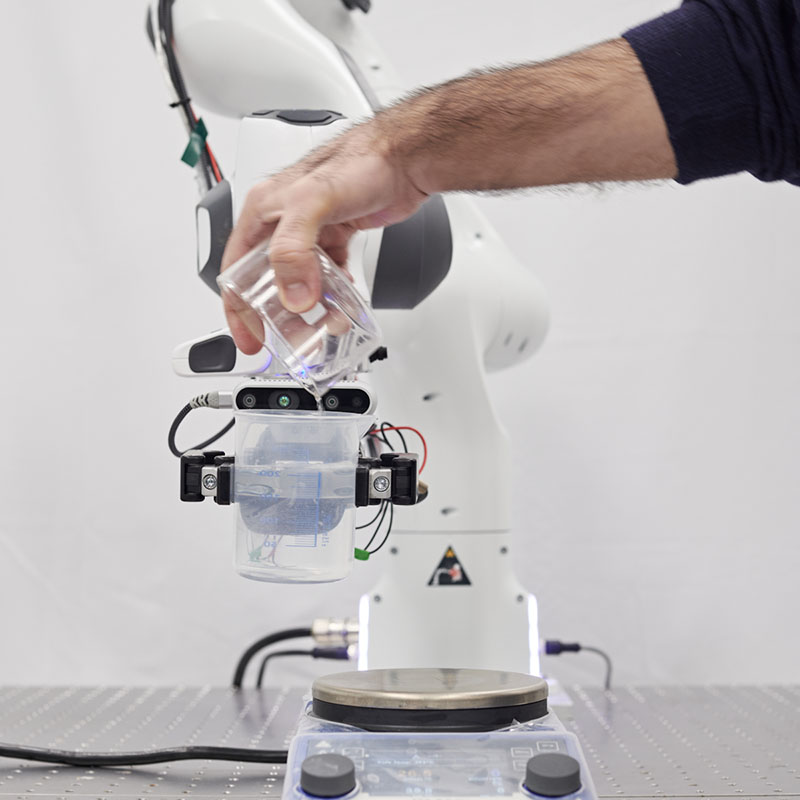
The Acceleration Consortium is on a mission to accelerate the discovery of new molecules and materials. In the pursuit of that goal, the AC is providing startup packages to support new University of Toronto (U of T) faculty who are developing self-driving labs (SDLs) at the university.
Supported by the AC’s Canada First Research Excellence Fund (CFREF) grant, the AC faculty Accelerator award is one way the AC is helping to build expertise and capacity at U of T by attracting top talent to the university who will either apply accelerated discovery to their research or study the economic, social and ethical implications of accelerated discovery. This year, two world-class scholars joined the Department of Chemical Engineering & Applied Chemistry at U of T and received this funding, Drs Benjamin Sanchez-Lengeling and Weilai Yu.
“We’re building the future of materials discovery right here at U of T,” said Alán Aspuru-Guzik, director of the Acceleration Consortium. “Our Faculty Startup Accelerator award has allowed the university to recruit two researchers who are the leaders in their fields. I am excited to work with Drs Sanchez-Lengeling and Yu to build the SDL facilities we need to accelerate discovery.”
Benjamin Sanchez-Lengeling
Dr. Benjamin Sanchez-Lengeling joined the University of Toronto after working at Google DeepMind and earning his PhD from Harvard. His research focuses on using data and computer models to solve problems in chemistry. He creates and tests new tools that help discover and understand molecules, including small molecules, plastics, chemical mixtures, and proteins. Dr. Sanchez-Lengeling works closely with other scientists to turn computer predictions into real-world experiments, making sure the results are easy to understand and interpret.
“I am excited to answer the question, ‘How do we make lab work faster, easier and cheaper?’” said Dr. Sanchez-Lengeling. “My goal is to create tools the scientists want and that will make us better scientists. It is important to ask ourselves what we can learn from our processes and establish ways to quantify how we are making people more capable. Are they saving time? Are they happier? It is important to apply rigour to these claims.”
“The Accelerator award will help me build a good support structure such as hiring students and acquiring computation, to develop ideas and the time to build and support a rigorous research agenda,” continued Dr. Sanchez-Lengeling. “I wanted to join U of T because there is a culture of sharing in Canada that I am excited to be part of. As I build my lab, I can explore other labs, and we can coexist and expand. Science requires many people and a lot of different expertise, which is exactly the model that the Acceleration Consortium is building.”
Weilai Yu
Dr. Weilai Yu joined U of T from Stanford University. His research program integrates fundamental electrochemistry, surface science, and functional material-interface design toward developing next-generation battery technologies. Dr. Yu will be addressing the challenge of extending battery longevity through the development of new materials in his work.
“With the rise in demand for electric vehicles, consumers need batteries that will last longer and allow them to cover more distance between charges––that’s where our work comes in,” said Dr Yu. “This funding package will allow us to explore interface formation in high throughput experimentation. In the next two years, I’ll be able to hire grad students, and build the tools we need to build batteries better.”
“When I was touring the University of Toronto as part of my hiring process, the Chemical Engineering Department chair showed me the construction happening at the Lash Miller building and told me about the Acceleration Consortium. It was fascinating to me,” continued Dr. Yu. “The Acceleration Consortium is the only place doing state-of-the-art research with self-driving labs and I wanted to be part of it.”
The AC will support up to 10 more faculty awards. Applications to the Accelerator award must come from the academic lead (chair/dean/principal) of the hiring unit. To access the complete application guidelines or if you have any questions, please email sean.caffrey@utoronto.ca. Applications are open to all departments that are working in the field of accelerated discovery and are considered on a rolling basis.