AC-U of T researchers unveil new AI agent for quantum chemistry
AC research trio co-create El Agente Quntur, a new AI research collaborator, with Matter Lab team

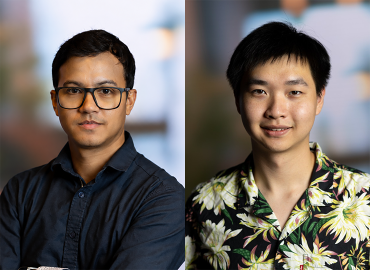
U of T Postdoctoral Fellow Dr. Juan B. Pérez-Sánchez and Yunheng Zou, a third-year computer science PhD student, both with the Matter Lab, are co-lead authors of a new paper in Chem which presents El Agente Quntur, a new AI agent designed for supporting researchers using quantum computational chemistry.
“Computational quantum chemistry uses methods based on quantum mechanics to calculate molecular properties, including energies, geometries, and even the color of light that they absorb. El Agente Quntur is designed to answer chemical questions through a series of these calculations. It can consult scientific literature and software documentation, choose and run calculations, analyze results, and revise its approach when a calculation fails or raises a new question,” says Dr. Pérez-Sánchez, whose co-authors also include the Acceleration Consortium's director, Professor Alán Aspuru-Guzik and AC Staff Scientists Eric Isbrandt and Han Hao, among others.
“We describe Quntur as a 'research collaborator' because it can plan and carry out a substantial investigation without a the Matter Lab researcher specifying every step. It makes choices about methods, responds to what the calculations reveal, and works toward a chemical interpretation.”
He notes that while they have worked to decrease the chances of AI hallucinations or other errors, “Agentic systems still make mistakes. We have worked to identify where they fail systematically and to use those findings to improve Quntur’s reliability. Researchers will remain responsible for critically assessing its methods and conclusions.”
(Learn more about the Matter Lab’s El Agente ecosystem)
Pérez-Sánchez is Colombian, and says he has always been interested in science, particularly physics. "I chose to study chemistry because it offered a way to explore questions across disciplines, from biochemistry and environmental science to physics.”
“I completed my undergraduate and master’s studies in chemistry at Universidad del Valle in Cali, Colombia. There, I began studying how molecules vibrate when exposed to intense infrared laser light and whether that interaction could be used to control the breaking of chemical bonds. I moved to the United States to earn my PhD in Chemistry and Biochemistry at the University of California, San Diego, under the supervision of Prof. Joel Yuen-Zhou and continued studying interactions between light and matter, developing theoretical methods to describe what happens when light and molecules interact so intimately that they behave as a single hybrid entity called a polariton.”
He joined the Matter Lab as a University of Toronto postdoctoral fellow, because the scientific progress enabled by the application of machine learning to chemistry had become impossible to ignore. “The Matter Lab, led by Professors Alán Aspuru-Guzik and Varinia Bernales, is a pioneer in this area. My research now explores how AI agents can manage the use of scientific software and accelerate computational chemistry.”
Computational quantum chemistry is a mature field, requiring considerable expertise. A newcomer must decide which methods are appropriate for a given research question, learn the conventions of specialized software, prepare and run calculations, and determine whether the results are reliable.
“A calculation can finish successfully and still give a misleading answer if the method or assumptions are wrong. Interpreting the output in chemical terms requires another layer of judgment. A chemist could spend an entire PhD learning to make these decisions well within just one area of the field.”
Pérez-Sánchez added, “My vision for El Agente Quntur is that it lowers this barrier by taking on much of that work: consulting the literature and software documentation, choosing and carrying out calculations, troubleshooting problems, and analyzing the results. I want researchers to be able to investigate chemical questions without first having to master every technical detail of the methods and software they need.”
“Our group’s first system, El Agente Q, showed that an agent could carry out quantum-chemistry calculations in response to a researcher’s request. The turning point for Quntur was realizing that large language models had become much more capable. We needed to rethink how we built agents around them.”
“This was the 'bitter lesson' playing out in our own project: rules we had written to help the first system were becoming constraints as the models improved. With Quntur, we moved away from prescribing every step and focused on providing agents with more general, composable tools and access to scientific literature and software documentation while they work.”
“The challenge is to know where that support is actually needed. As we tackle more complex problems, the knowledge a model acquired during training may be insufficient for a particular decision. We try to identify what the model can already handle, then provide additional documentation or better infrastructure where it needs help,” says Pérez-Sánchez.
“Quntur also retains an important idea from previous versions: a quantum-chemistry-specific system of delegation that guides how agents divide and approach a problem. In the manuscript, we systematically examine the resulting system’s capabilities and recurring limitations, rather than treating its performance as a matter of finding the right prompt.”
Yunheng Zou, the other lead author on the Chem article, agrees. “What excites me most about this work is that it shows we can build a flexible, adaptive agentic system without relying on extensive human feedback,” he says. "Instead of providing detailed, finely tuned instructions, we give agents general directions for their reasoning to encourage deeper thinking within a scientific domain.”
"This approach aims to maximize their ability to generalize across problems, allowing them to handle different scenarios flexibly while maintaining sound practices in the field. It allows us to customize agents in an efficient, scalable way while achieving the level of sophistication we want.”
Zou is from Nantong, China, a small city near Shanghai, and is currently a third-year computer science PhD student in the Matter Lab. “My dream is to build AI scientist systems that can investigate deep scientific problems at scale. This includes both building useful agents for different scientific domains and training models that provide domain-specific intelligence or serve as tools.”
“My current research explores how to develop chemistry agents that can tackle challenges in chemistry research autonomously, as well as how to post-train large language models.”
As for what comes next for El Agente Quntur, Zou says: “We envision adding many more capabilities to the agent, including domain-specific enhancements. We want it to handle transition states reliably and to build and edit molecular geometries.”
"We also want agents to tackle longer investigations, such as proposing complete chemical reaction pathways. As we outlined in the paper, we want Quntur to collaborate with other agents within the El Agente ecosystem. We are advancing rapidly in some of these areas. We are actively exploring the boundaries of these capabilities and developing robust benchmarks and verification methods to test these agentic systems.”
“As the underlying models make significant progress, the system will be able to tackle more problems, both in carrying out calculations and in reasoning through scientific questions.”
By reducing technical barriers, in other words, and helping scientists focus on interpretation, creativity, and discovery, the researchers hope to make powerful computational tools accessible to a broader community.
Republished from the Department of Chemistry